1
The instrument maps the restricted tissue.

Instrument-assisted soft tissue work for scar tissue and stubborn tendon pain, followed by the loading that rebuilds it.
What It Is
Graston Technique is a specific, branded system of instrument-assisted soft tissue mobilization (the broader category is known as IASTM). A set of stainless steel instruments, each shaped for a different contour of the body, is swept along the tissue in question instead of a thumb.
The instrument does two jobs at once. It picks up dense, restricted tissue that your therapist can feel right through the handle, and it delivers a controlled amount of pressure to that exact spot for longer than a hand can hold it.
It earns its place where an old scar, a healed strain, or a cranky tendon has left an area thickened and unwilling to slide. Treatment is followed by loading in the same visit, because tissue remodels around how you use it.
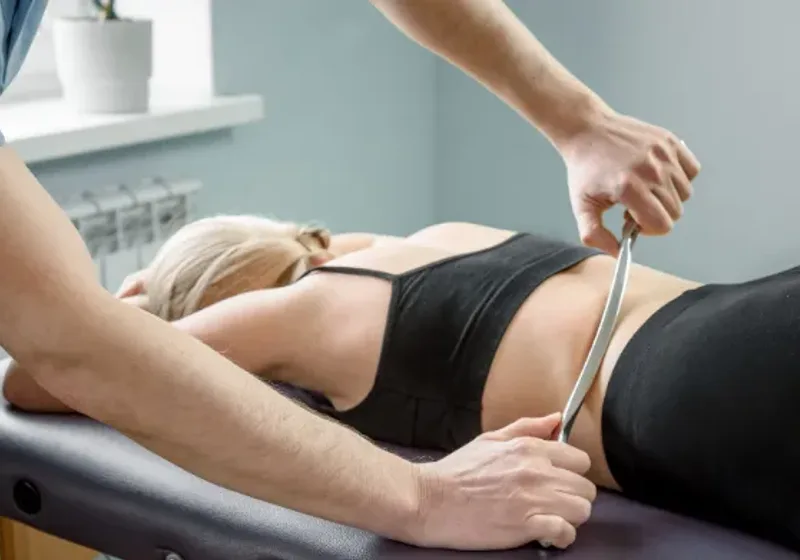 Instrument-assisted, evaluation-led
What It Helps
Scar tissue and tendon pain don’t answer to stretching. They answer to work on the tissue and then load.
What A Session Looks Like
1
The instrument maps the restricted tissue.
2
We work that exact area, at your pressure.
3
We load the tissue before you leave.
Why It Works
Finds restriction fingers walk right past.
Precise pressure, held where it counts.
Built for scar tissue and tendon pain.
Followed by loading, so tissue remodels.
Pairs Well With
Questions, Answered
IASTM stands for instrument-assisted soft tissue mobilization, and it’s the category. Graston Technique is a well known, branded instrument system inside that category, and it is the one we use on this page. If you are looking for the broader category, visit our IASTM page.
Most people describe it as gritty and firm over the restricted spot, then noticeably lighter as it clears. Some skin redness afterward is normal and it fades. Pressure is adjustable and it’s your call, so tell your therapist and it changes right then.
Often, yes, as long as the incision is fully healed. Scar tissue can tether the layers around it and change how the whole area moves, which is why people feel pulling far from the scar itself. Your evaluation tells us whether the scar is actually part of your problem or just the most visible thing.
Book Your Visit
Request a time and a real person calls you back, usually within two business hours. No phone tree. No ‘someone will reach out.’ Just a plan.
5.0 · 200+ Google reviews
Typical response: under 2 business hours
Step 1 of 5
That’s the hard part done. We’ll call during business hours to lock in your time.
Visit Us