Weeks 1–2
Pain
Calm the pain down.
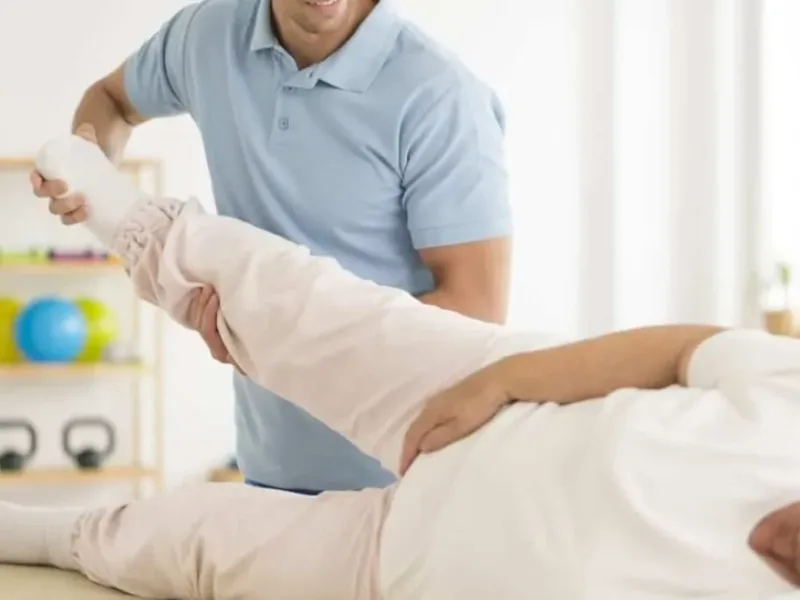
Settle the pain down first, with hands-on treatment and the loading your hip or knee can actually tolerate right now.

What We Treat
The pinch when you get out of the car, or the stairs you now take one at a time. Both are fixable, and both start with a cause-first evaluation, not a guess.
Sound Familiar?
Two or more? Keep reading.
Why It Happens
It is almost never just one thing, and the hip and knee are especially connected: weak or under-active glutes let the hip drop and rotate inward with every step, and the knee absorbs the difference. On the hip side, it is often a joint that has lost rotation and started pinching at the end of range, or a hip flexor doing the work muscles around it should share. On the knee side, it is often a kneecap that is not tracking cleanly through the groove, or an ankle and hip that have stopped moving so the knee compensates.
Add in a load pattern from running, sitting or standing that keeps aggravating the same tissue, and you have a real, findable cause, not a mystery. That is why rest, ice, or a generic stretching sheet so often falls short: they treat the symptom, not the source. A cause-first evaluation sorts out which of these is actually driving your pain, and the fix gets obvious.
The Honest Truth
Nobody regrets starting too early. Every week, someone in our clinic says they regret waiting.
How We Fix It
Every plan has an endpoint. Here’s what the four phases look like for a hip or knee.
Weeks 1–2
Pain
Settle the pain down first, with hands-on treatment and the loading your hip or knee can actually tolerate right now.
Weeks 2–6
Prime
Rebuild the motion and the control your hip or knee lost, so the strengthening has something to work with.
Weeks 6–10
Perform
Load it properly, and take your hip or knee back to the thing you actually want to do rather than to a generic exercise sheet.
Weeks 10+
Prevent
Keep it. You leave with the small amount of work that holds the result, and a clear endpoint rather than an open tab.
I began working with Kinley two months ago to address knee and hip discomfort and to improve my running form for upcoming marathon training. Kinley efficiently identified the underlying issues and provided targeted exercises to enhance my strength and mobility. After following her recommendations, I have noticed improvements in both my leg strength and my running technique. Kinley is patient and designs practical routines that are manageable on a weekly basis between my appointments. I look forward to working with her more and seeing even more improvements!
Dhyana P. · Hip & knee pain · via Google
AIM Physical Therapy is exceptional. I just finished my three-month rehab for a total knee replacement and am very satisfied with my outcome. As a retired physical therapist myself and former outpatient supervisor, I am aware that this procedure’s ultimate success occurs not only through the surgeon’s skill and the motivation of the patient, but also the clinical expertise and attitude of the physical therapist involved in the post-op phase of recuperation. To be certain that I linked up with a facility that would help me to achieve my goals, I visited four physical therapy centers in my proximity pre-operatively and met each time with a physical therapist. Without question, AIM came out ahead. I met with Kinley and was so impressed that I requested her as my PT. She did not disappoint. Her professionalism, clinical expertise, and attitude made a tough rehabilitation easier. In addition to the excellent and caring staff, the facility is spacious, clean, and well-equipped. If you are referred for physical therapy, I would highly recommend that you consider AIM Physical Therapy.
Marian S. · Knee pain · via Google
Questions, Answered
Usually not, and it is rarely the first step. Imaging is useful when it would change the plan, and a lot of the time it does not: scans routinely show wear and tear in people who have no pain at all. A hands-on evaluation tells us how you actually move, which is what the treatment is built on. If your case does warrant imaging or a specialist, we will say so and help you get there.
Yes, in most cases movement helps more than rest does. Hurt doesn’t always mean harm, total rest tends to make a joint stiffer and weaker, which sets up the next flare-up. The key is dosing the right movement for your specific hip or knee, which is exactly what a Doctor of PT sorts out at your evaluation, then progresses safely as you improve.
That depends on what the evaluation finds, and you will get a straight answer at that first visit rather than an open-ended course of care. Every plan here has a defined endpoint, and we tell you what it is before you commit to it.
Book Your Visit
Request a time and a real person calls you back, usually within two business hours. No phone tree. No ‘someone will reach out.’ Just a plan.
5.0 · 200+ Google reviews
Typical response: under 2 business hours
Step 1 of 5
That’s the hard part done. We’ll call during business hours to lock in your time.
Visit Us